How to Choose a Mini Fridge: Size, Freezer and Noise
Choose a mini fridge size that holds your usual food and drinks while leaving room for ventilation and door swing. Pick the freezer layout before comparing outside dimensions.
On this page (10 sections)
- What mini fridge size fits your room and routine?
- How do you measure for a mini fridge?
- Should your mini fridge have a freezer?
- How loud is a mini fridge near a bed or desk?
- Which storage features will you actually use?
- Which mini fridge examples fit different needs?
- How should you set up a mini fridge for daily use?
- What care does a mini fridge need?
- Which buying mistakes waste the most space?
- Which mini fridge size should you choose?
Choose a mini fridge size that holds your normal food and drink supply and fits with room for airflow and an open door. Decide whether you need frozen storage first, since a chiller or freezer compartment changes how much space remains for fresh food.
For a few drinks and snacks, a short cabinet may be enough. For packed lunches, leftovers or shared use, focus on shelf space and container fit before choosing the smallest footprint.
What mini fridge size fits your room and routine?
The right size depends on your busiest storage day, not just the number of people using the fridge. A person who keeps several meal containers may need more room than 2 people storing only drinks.
Start with what will be inside after a normal grocery trip. Count lunch boxes, milk, leftovers, fruit and drinks, including anything that needs to stand upright.
Then separate daily essentials from occasional overflow. Buying enough room for a rare party can leave you with a larger cabinet than your room needs all year.
Match mini fridge capacity to your actual containers
Use capacity as a starting point, then check the shapes you need to store. Cubic feet describe volume, but don't show whether a wide lunch container fits beside a bottle.
A short fridge can suit a bedside drink supply or a few work snacks. A taller cabinet makes more sense when you need separate places for drinks, lunches and leftovers.
These examples show how much outside dimensions vary. They are model-specific measurements, not standard sizes for every fridge in each capacity range.
| Example | Capacity | Outside size (W x D x H) | Layout |
|---|---|---|---|
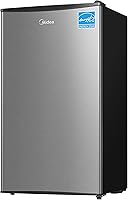
| Midea 1.6 Cu Ft Mini Fridge | 1.6 cu ft | 18.6 x 17.7 x 19.4 in | Internal chiller compartment |
| Igloo 3.2 Cu Ft Mini Fridge with Freezer | 3.2 cu ft | 17.13 x 18.63 x 32.5 in | Internal 0.2 cu ft freezer compartment |
| Frigidaire 4.5 Cu Ft Platinum Compact Refrigerator | 4.5 cu ft | 22 x 21 x 32 in | Internal 0.3 cu ft freezer compartment |
| Midea 3.3 Cu Ft Low-Noise Mini Fridge | 3.3 cu ft | 18.6 x 17.7 x 33.9 in | Freezerless |
The 2 Midea models share the same stated width and depth, but the taller model offers more capacity. The Frigidaire is wider and deeper, yet shorter than either of the other tall cabinets.
If floor space is tight, compare height before giving up storage volume. If a desk or counter limits height, start with that limit instead.
How do you measure for a mini fridge?
Measure the installation space, open-door space and delivery route before choosing a model. Closed-door dimensions alone won't tell you whether the fridge works in that spot.
- Measure available width, depth and height at the narrowest points.
- Include baseboards, trim, counter edges and nearby furniture.
- Add the exact model's required ventilation gaps.
- Allow space for the plug without crushing or sharply bending the cord.
- Check that the door can open far enough to reach food and remove shelves.
- Measure doorways, hallway turns and stairs along the delivery route.
Mark the proposed footprint on the floor with removable tape. Open nearby drawers and room doors to see whether the fridge will block a path you use every day.
Check the hinge side too. The 2 Midea models and the Frigidaire have reversible doors; the Igloo has a left-opening door.
A reversible door helps with placement, but it doesn't remove the need for clearance beside the hinge. Follow the door-reversal instructions and confirm the new swing works before loading the cabinet.
All 4 examples are freestanding models. A flush-back shape or short cabinet doesn't make a fridge suitable for a sealed cupboard or tight built-in opening.
For the wider layout choices, our mini fridge size and type guide explains how different formats fit common uses.
Should your mini fridge have a freezer?
Choose a freezer compartment only when you have a regular frozen-storage need. For drinks, yogurt, fruit and packed lunches, a freezerless layout keeps the choice focused on chilled storage.
Write down the frozen items you expect to keep. A few small portions need a different layout from stacked meal boxes or a large bag of frozen vegetables.
The Igloo and Frigidaire have small internal freezer compartments behind a single outer door. Compare the shape of your usual packages with the compartment's usable space, rather than relying on total fridge capacity.
The small Midea has a chiller box, which shouldn't be treated as a replacement for dedicated frozen storage. Follow its instructions for what belongs there.
The taller Midea is freezerless. Choose it when you already have a freezer elsewhere or don't plan to keep frozen food in this room.
For regular frozen-food storage, check the model's freezer temperature guidance as well as its dimensions. An internal compartment's presence alone doesn't establish that it suits every frozen item or storage period.
Our guides to mini fridges with freezers and mini fridges without freezers help narrow that choice before you compare cabinet sizes.
How loud is a mini fridge near a bed or desk?
Expect some compressor sound, and choose a location where normal cycling won't distract you. A bedroom at night makes appliance sounds more noticeable than a busy kitchen.
Midea claims noise below 42 dB for both models here. Igloo describes its compressor as quiet, but there's no matching decibel figure here for a direct comparison.
Treat those claims as one part of the choice. Distance from your pillow or chair, floor stability and contact with nearby furniture also affect what you hear.
Put the fridge on a firm, level surface that supports its weight. Avoid letting the cabinet touch a desk, wall or bed frame, where vibration can become more noticeable.
Don't pack soft material around the fridge to muffle it. That can block ventilation and make the installation unsuitable.
If sleep is the main concern, choose the location before choosing the model. Our quiet mini fridge guide covers options for rooms where sound matters most.
Which storage features will you actually use?
Prioritize container fit and easy access over a long feature list. A rack helps only when it suits what you normally put in it.
Bottle storage can free shelf space for lunches, but a door full of bottles also needs room to swing open. Check that the door won't hit furniture when loaded.
Removable shelves help with tall or irregular items. Think through the trade-off: making space for a large container can remove a whole storage level for smaller food.
Can racks suit a steady supply of canned drinks. If you mainly store reusable bottles and food boxes, give more weight to open shelf space.
An interior light is useful in a dim office or bedroom. Leveling legs matter when you need to steady the cabinet, but they don't make a weak or sloping support surface suitable.
Before ordering, measure your largest everyday container. Its width, depth and height will tell you more about usable storage than a photo of loosely arranged drinks.
Which mini fridge examples fit different needs?
Choose among these models by height limits, chilled-food volume and frozen-storage needs. Each solves a different space problem, so the largest cabinet isn't automatically the best choice.
Midea 1.6 Cu Ft Mini Fridge: a short mini fridge size
Choose the small Midea for personal drinks and a light snack supply when available height rules out a taller fridge. It suits someone who restocks often and keeps their main groceries elsewhere.
Its removable glass shelf lets you trade a storage level for taller items, while the 2-liter bottle rack gives a large bottle a defined place. Plan around the remaining shelf area if lunch containers are part of your routine.
This is a sensible choice beside a desk or in a room used mainly for drinks. Keep it within easy reach on a suitable support surface, with the required ventilation space.
Skip it for weekly meal storage or shared groceries. The short cabinet saves vertical space, but it leaves less room to separate several containers, and the chiller isn't a reason to choose it for frozen meals.
Igloo 3.2 Cu Ft Mini Fridge with Freezer: mixed personal storage
Choose the Igloo for lunches, drinks and a small frozen-food supply when cabinet width is tight. It offers a middle ground between a short snack fridge and the wider Frigidaire.
The glass shelves, tall bottle racks and vertical can storage suit a mix of food and drinks. Its fresh-food section provides 3 cu ft, so most of the cabinet is devoted to chilled storage.
The mechanical thermostat gives you control over cooling, but dial position isn't a food-temperature reading. Use an appliance thermometer to check the setting you choose.
Skip it if you need bulky frozen packages or a reversible door. Its small freezer is better treated as a limited extra space, and the hinge direction needs to work with your room from the start.
Frigidaire 4.5 Cu Ft Platinum Compact Refrigerator: larger shared supplies
Choose the Frigidaire for a larger drink and snack supply when you have more width and depth available. It has the greatest total capacity of these examples.
The glass shelves and removable food shelves help organize containers, while the door storage gives bottles and cans their own places. This layout suits shared snacks or overflow from a main kitchen.
Its leveling legs help steady the cabinet, and the recessed handle avoids a projecting grip. The flush-back design still needs the ventilation space required by its instructions.
Skip it for a narrow bedside gap or a freezer-heavy routine. The larger total capacity doesn't turn its internal freezer into roomy frozen storage, and its footprint deserves a careful tape-measure check.
Midea 3.3 Cu Ft Low-Noise Mini Fridge: fresh food without frozen storage
Choose the taller Midea for office lunches and chilled groceries when you don't need a freezer in the room. Its freezerless layout keeps the cabinet devoted to fresh-food storage.
The interior light helps you see food in a dim room, while the bottle and can racks separate drinks from shelf items. Its multi-air-flow system circulates air through the refrigerator.
It makes sense for someone with access to a freezer elsewhere who wants more room than a short personal fridge provides. The narrow footprint also suits spaces where extra width is harder to spare than height.
Skip it if ice or frozen meals are a daily requirement. Don't plan to use a refrigerator's coldest setting as a substitute for a freezer, and check its height against any desk or counter above it.
How should you set up a mini fridge for daily use?
Set the fridge on a stable surface with clear ventilation, then follow its startup instructions before adding food. Good placement matters as much as choosing the right capacity.
Keep it away from strong heat sources and direct sun where practical. Make sure room conditions fall within the model's operating limits, especially in an unheated or very hot space.
If the fridge was tilted during transport, follow the manufacturer's standing-time instructions before plugging it in. Don't guess a universal waiting period.
Use the outlet and cord arrangement required by the manual. Keep the plug accessible so you can disconnect the fridge for cleaning or maintenance.
Let the cabinet reach its intended storage temperature before adding perishable food. Check with an appliance thermometer rather than assuming the dial numbers equal degrees.
Load food so air can move around it. Avoid pressing containers tightly against interior walls or blocking any air openings.
Put frequently used items where you can reach them without rearranging the whole shelf. If every drink requires moving lunch boxes, the layout needs adjusting or the fridge is too small for that load.
What care does a mini fridge need?
Keep spills, seals and airflow paths clean, and deal with frost according to the model's instructions. A little empty space makes these jobs easier.
Wipe spills before they collect under containers, and clean door seals gently so crumbs don't interfere with closing. Dry cleaned surfaces before returning food.
Check dates and remove forgotten leftovers before restocking. This prevents old food from taking up the space you bought the fridge to provide.
For routine cleaning steps, follow our mini fridge cleaning guide. Keep water away from electrical parts and use cleaning products suitable for the interior.
Frost buildup needs attention on models that require manual defrosting. Follow our mini fridge defrosting guide and the appliance instructions, and never chip ice away with a sharp tool.
Leave access for any exterior cleaning the manual requires. A fridge wedged into an unreachable gap can be awkward to maintain even if the door opens.
Which buying mistakes waste the most space?
Avoid choosing by capacity alone or buying a freezer you won't use. Both mistakes can leave you with a cabinet that occupies the room poorly.
- Measuring only the closed cabinet: Leave room to open the door, reach the back and remove shelves.
- Assuming a bigger total means a bigger freezer: Compare the frozen compartment separately from overall volume.
- Planning around cans alone: Include lunch boxes, reusable bottles and tall cartons in your storage plan.
- Ignoring restocking habits: Frequent small shops need less holding space than a weekly grocery trip.
- Filling every gap with food: Leave room for airflow and enough visibility to find what you have.
- Choosing a tight furniture opening: Required ventilation is part of the footprint, even when the cabinet itself fits.
Also check the rules for the room before ordering. Dorms, workplaces and rented spaces may restrict appliance size, placement or use.
Which mini fridge size should you choose?
Choose your mini fridge size by ruling out models that fail your space or storage needs. Then pick the layout that holds your normal supply without constant rearranging.
- Pick the short Midea for personal snacks and drinks when height is the main limit.
- Pick the Igloo for mixed chilled storage and a small frozen supply in a narrow cabinet.
- Pick the Frigidaire for larger shared supplies when you can spare more floor space.
- Pick the taller Midea for lunches and fresh food when you have no use for a freezer.
Before ordering, confirm 3 things: your largest container fits, the door opens fully enough for daily use, and the required airflow gaps fit the room. Those checks turn a capacity choice into a fridge you can use comfortably.
For alternatives within your chosen layout, continue with our best mini fridges guide.
Sources
- Midea 1.6 Cu Ft Mini Fridge: See it on Amazon
- Igloo 3.2 Cu Ft Mini Fridge with Freezer: See it on Amazon
- Frigidaire 4.5 Cu Ft Platinum Compact Refrigerator: See it on Amazon
- Midea 3.3 Cu Ft Low-Noise Mini Fridge: See it on Amazon
Frequently asked questions
How do I choose a mini fridge size?
Choose a mini fridge size around your usual food and drink supply, then check the cabinet dimensions. Include your largest containers, ventilation gaps and door swing in the plan.
Measure the delivery route too, because a fridge that fits its final spot may not pass through a narrow turn.
Is a freezer compartment worth it in a mini fridge?
A freezer compartment is worth having if you regularly store small frozen items and its storage instructions support that use. Check usable space and freezer temperature requirements before buying.
For bulky frozen meals or a weekly frozen-food supply, compare a separate freezer layout rather than choosing by total fridge capacity.
Are mini fridges quiet enough for a bedroom?
Some mini fridges can suit a bedroom, but no compressor fridge should be assumed silent. Compare brand noise claims, then plan a firm, level spot away from your pillow and touching furniture.
Compressor cycles and vibration can stand out more at night than during normal daytime activity.
How much space should I leave around a mini fridge?
Leave the ventilation gaps required by the exact model's installation instructions, plus space for the plug and door to open. There isn't one clearance rule for every mini fridge.
A freestanding cabinet shouldn't be enclosed in furniture unless its instructions allow that installation and you can maintain the required airflow.
Do mini fridge dimensions include the door handle?
Don't assume published dimensions include every handle, hinge or other projection. Confirm what the measurements cover before planning a tight fit, and measure enough space to open the door and remove shelves.
Check packaged dimensions separately if the boxed fridge must pass through a narrow doorway or hallway.